Dark Mode
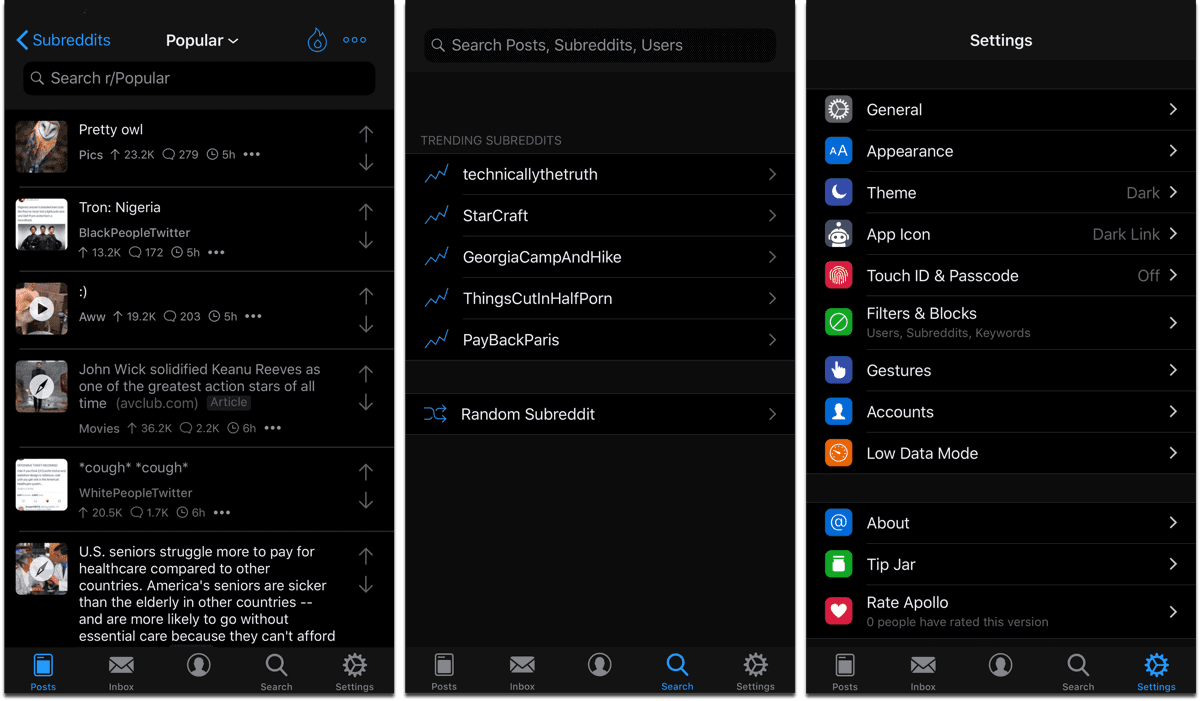
In iOS 13.0 and later, people can choose to adopt a dark system-wide appearance called Dark Mode. In Dark Mode, the system uses a darker color palette for all screens, views, menus, and controls, and it uses more vibrancy to make foreground content stand out against the darker backgrounds. Dark Mode supports all accessibility features.
Dark Mode
Light mode
In Settings, people can choose Dark Mode as their default interface style and schedule automatic changes between the appearance modes. Because people make these choices at a systemwide level, they generally expect all apps to respect their preferences.
Comply with the appearance mode people choose in Settings. If you offer an app-specific appearance mode option, you create more work for people because they have to adjust more than one setting. Worse, they may think your app is broken because it doesn't respond to their systemwide appearance choice.
Dark mode was introduced with macOS Mojave (10.14) and released in the fall of 2018. Macs using older versions of macOS or OS X like High Sierra and Sierra are unfortunately not able to use dark mode but can enable a dark menu bar and dock. Enabling or disabling dark mode can be done via the Mac. To turn Dark Mode off, select the Turn off Dark Mode checkbox. OneNote will return to its default light appearance, even if your Mac is still configured for Dark Mode. To turn Dark Mode back on, clear the Turn off Dark Mode checkbox. OneNote will return to matching your Mac’s current appearance setting—Light, Dark. May 12, 2020 The Apple Store app is Apple's dedicated app for purchasing new Apple products and scheduling Today at Apple sessions on the iPhone and the iPad, and a Dark Mode option will be. Oct 20, 2018 Dark mode lets us protect our eyeballs from the harsh glare of a white screen, and it may just conserve a little more battery life on our mobile devices. Microsoft Teams has such a mode. Enabling dark mode. To enable dark mode, log onto Microsoft Teams and select your profile picture in the. Oct 02, 2018 This lets you, say, use the Dark theme in Spark while your Mac is set to use Light Mode. “According to System Preferences” is the default setting. Setting Spark to always use its Dark or Light theme applies the correct look throughout the app—regardless of whether your computer is set to use Mojave’s Dark or Light Mode.
Test your designs in both light and dark appearances. See how your interface looks in both appearances, and adjust your designs as needed to accommodate each one. Designs that work well in one appearance might not work in the other.
Ensure that your content remains comfortably legible in Dark Mode when you adjust the contrast and transparency accessibility settings. In Dark Mode, you should test your content with Increase Contrast and Reduce Transparency turned on, both separately and together. You may find places where dark text is less legible when it’s on a dark background. You might also find that turning on Increase Contrast in Dark Mode can result in reduced visual contrast between dark text and a dark background. Although people with strong vision might still be able to read lower contrast text, such text could be illegible for people with visual impairments. For guidance, see Color and Contrast.
Dark Mode Colors
Chrome Dark Mode Mac
The color palette in Dark Mode includes darker background colors and lighter foreground colors that are carefully selected to ensure contrast while maintaining a consistent feel between modes and across apps.
In Dark Mode, the system uses two sets of background colors — called base and elevated — to enhance the perception of depth when one dark interface is layered above another. The base colors are darker, making background interfaces appear to recede, and the elevated colors are lighter, making foreground interfaces appear to advance.
Prefer the system background colors. Dark Mode is dynamic, which means that the background color automatically changes from base to elevated when an interface is in the foreground, such as a popover or modal sheet. The system also uses the elevated background color to provide visual separation between apps in a multitasking environment and between windows in a multiple-window context. Using a custom background color can make it harder for people to perceive these system-provided visual distinctions.
Use dynamic colors that adapt to the current appearance. Semantic colors like separator automatically adapt to the current appearance (for guidance, see Dynamic System Colors). When you need a custom color, add a Color Set asset to your app’s asset catalog and specify the light and dark variants of the color so that it can adapt to the current appearance mode. Avoid using hard-coded color values or colors that don’t adapt.
Elevated
Ensure sufficient color contrast in all appearances. Using system-defined colors ensures a proper contrast ratio between your foreground and background content. For custom colors, aim for a contrast ratio of 7:1, especially for smaller text. For guidance, see Dynamic System Colors.
Soften the color of white backgrounds. If you must use a white background for your content in Dark Mode, choose a slightly darker white that prevents the background from glowing against the surrounding dark content.
For related guidance, see Color.
Image, Icon, and Symbol Color
The system uses SF Symbols, which automatically look great in Dark Mode, and full-color images that are optimized for both light and dark appearances.
Use SF Symbols wherever possible. Symbols look great in both appearance modes when you use dynamic colors to tint them or when you add vibrancy.
Design individual glyphs for light and dark appearances when necessary. A glyph that uses a hollow outline in light mode might look better as a solid, filled shape in Dark Mode.
Make sure full-color images and icons look good. Use the same asset if it looks good in both light and dark modes. If an asset looks good in only one mode, modify the asset or create separate light and dark assets. Use asset catalogs to combine your assets into a single, named image.
Materials
Vibrancy can help maintain good contrast of text on darker backgrounds.
Use the system-provided label colors for labels. The primary, secondary, tertiary, and quaternary label colors adapt automatically to light and dark appearances. For related guidance, see Typography.
Use system views to draw text fields and text views. System views and controls make your app’s text look good on all backgrounds, adjusting automatically for the presence or absence of vibrancy. When possible, use a system-provided view to display text instead of drawing the text yourself. For developer guidance, see UITextField and UITextView.
To learn more about the interplay of vibrancy and materials, see Materials.
Simple. Powerful. All at once.
Reimagine your productivity. 2Do is now more powerful than ever.
Watch Tutorials | Mac App Store
Requires OS X 10.10. Made for 10.14 Mojave. Works on 10.15 Catalina.
Long awaited Actions have landed on OS X. Now you can Add URLs, addresses, or Google searches to your tasks send texts or even call right from 2Do on Mac.
Utility Panel
The New Utility panel now accomodates tags, all new Nearby feature and soon a Calendar Events view. Quickly switch to the function you need with just one click or hide the panel altogether.
Regular search doesn’t cut it? Build your own complex query with a search builder and make them into most advanced smart lists ever. You can even use logical operators and nested queries.
Quick Entry
Quick Entry works from anywhere and everywhere, just as it should – even when 2Do isn’t running. The design and layout is kept consistent with the default task editor, so there’s no learning curve.
GTD® Inbox
Sort by Tags
3rd Party CalDAV servers
Location search
Durations
Project view toggle
Task sharing
New Keyboard Shortcuts
Improved Calendar
Ready for Mojave
macOS 10.14 is no stranger for 2Do so we added new features just for Mojave
Widget
Access your tasks without even opening the app. Your Today list along with Starred and a custom list are handy from OS X’s notification center
Share Extension
2Do plays with other apps using extensions so you can create a task from 3rd party apps using a share sheet. Save selected text or URL with ease
New Design
A modern app has to keep up with current design trends.
Lists & Groups
Become organized. Keep related tasks and projects together under color coded lists and list groups.
Smart Lists
Create powerful perspectives of your tasks, saving you the time spent finding specific tasks otherwise.
Nearby
See only the tasks that matter. Get automatic alerts every time there’s something to be done nearby.
Sorting Methods
Sort your tasks as you like; 2Do offers the ability to sort each list separately.
Office Dark Mode For Mac
Printing
Print your list the way you see it, full partitioned and sorted. Or print a manual selection of tasks.
Focus Filter
Toggle between displayed tasks and filtered tasks based on a pre-defined set of focus options.
Cloud Sync
Keep all your devices running 2Do in sync. Choose from: Dropbox, Reminders (CalDAV) or Toodledo.
Protection
Your life is a private affair. Manage it by locking out individual lists or the whole app with a single tap.
Quick Look
Works like Finder, and allows you to quickly view task details without the need to edit.
Smart Scheduling
2Do automatically updates and refreshes the task list when the next task is due.
Automatic Backups
Auto Dark Mode Mac
Create and share backups for a rainy day. You have direct access to all your data and previous data-snapshots.
Localizations
English, Catalan, Chinese, Czech, Dutch, French, German, Italian, Korean, Japanese, Norwegian, Portuguese, Russian, Spanish, Swedish
2Do is a great choice for 99% of the Mac owners who are looking for a robust task manager to handle a variety of home and work tasks.
An excellent task manager with tons of feature, a great UI, and an excellent iOS companion app.
– AppstormThe Best Task Manager for iOS, 2Do, is Now Available for Your Mac.